Traffic 3D Parking: Escape Jam
- 4.9
- Rating
- 10.00M
- Installs
- Free
- Price
 Analysis by App-foxy
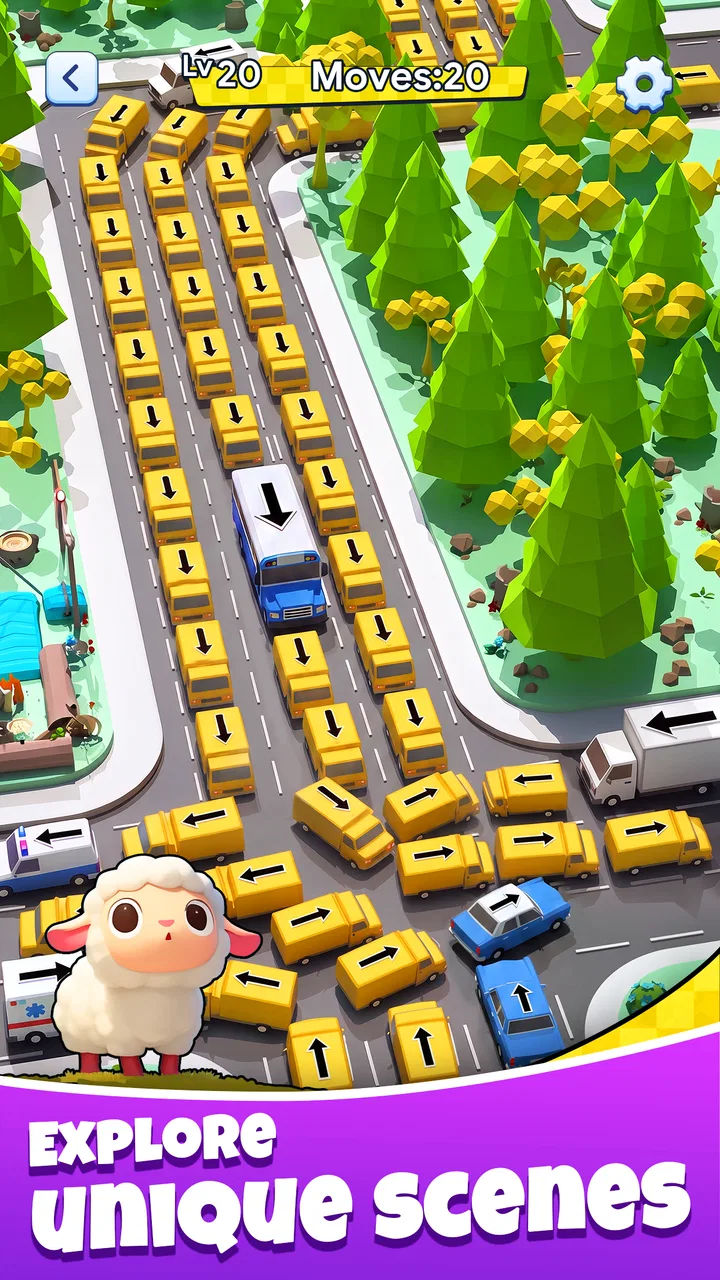
I went into Traffic 3D Parking: Escape Jam expecting a simple parking puzzle, but its appeal became clearer after a few rounds: every level asks me to read a crowded scene, choose the right car, and create enough space for the next move. It is a small, focused game from Pleasure City, built for quick decisions rather than long explanations. The action begins almost immediately, which makes it easy to pick up when I have only a few minutes.
The basic idea is familiar, yet the presentation gives it a satisfying twist. Cars are packed into a traffic jam, and I need to match colors while guiding vehicles out without making the situation worse. The challenge is not about steering through a realistic parking lot. It is about understanding order, space, and consequences. One careless move can turn an apparently open route into another blockage, so I quickly learned to pause and inspect the whole board before tapping.
That makes this a good fit for players who enjoy casual puzzle games with a clear objective and short attempts. It is also suitable for the Everyone age category, so the concept is approachable for a broad audience. I would not choose it for deep story, character development, or a long-form strategy experience. I would choose it when I want a compact mental exercise with a visible result at the end of each puzzle.
You May Also Like

 Blood Strike: 2.5 Anniversary
Blood Strike’s Loadouts Turn Every Drop Into a Tactical Gamble
A close look at Blood Strike’s custom loadouts: how fast access to signature weapons reshapes its battle royale rhythm, rewards preparation, and narrows the gap between fights.

 Pandora - Music & Podcasts
Pandora’s Music Is Easy to Start, but Harder to Recover
Pandora’s strength is its low-effort path from a seed to a station. Its weak spot is how much confidence it asks you to place in connection, setup, and quiet recovery.

 8 Ball Pool
 Is Built on Rivalries, Rematches, and Routine
A close look at the rivalries, rematches, shared routines, and unanswered safety questions that turn a quick pool match into a persistent mobile community.

 Samsung Music
’s Quiet Strength Is Playing What You Already Own
Its reach comes less from spectacle than from dependable access to a personal library. That simplicity is both the app’s strongest retention engine and its ceiling.

 AccuWeather: Weather Radar
AccuWeather Review: A Quick, Clear Forecast for Everyday Decisions
For everyday plans, the best forecast is the one you can understand quickly. AccuWeather makes rain timing, radar, and local conditions easy to act on, with a few trade-offs.

 Hill Climb Racing
Why Hill Climb Racing Still Turns Crashes Into One More Run
A tiny car, a bumpy hill and one more upgrade: Hill Climb Racing keeps resurfacing because its simple chaos makes every near-miss feel personal.
More From Our News Desk



How the parking loop feels in actual play
I focus on what makes each move feel consequential: the board is easiest to solve when I treat it as a set of dependencies, not a queue of cars to clear. That small shift helps me distinguish a move that merely works from one that opens options for everything behind it. From there, the next question is how the game’s current version fits into its longer-term development.
The first action is observation, not movement
The most useful habit I developed was resisting the urge to tap the first car that looked movable. At the beginning of a puzzle, I scan the exits, identify which vehicles are already aligned with their paths, and look for cars whose movement will open a lane for others. This turns the opening moment into a quick planning exercise. The board may look chaotic, but the solution usually starts with finding the move that reduces congestion rather than simply removing the nearest vehicle.
That first decision gives the game its personality. In many ordinary parking games, the main task is positioning a car accurately. Here, the more important question is which car should move now. A vehicle can be easy to remove but still be the wrong choice if it blocks another route or leaves the remaining cars in an awkward arrangement. I found myself treating each board like a small chain reaction, where one successful move changes the value of every option that follows.
The color-matching element also helps me read the board quickly. Instead of relying only on shape or location, I use the colors as visual clues for the intended relationships between cars and destinations. That makes the puzzle readable at a glance, although busy layouts can still demand concentration. If you are playing while distracted, it is easy to make a plausible move that later forces a reset.
Feedback makes each move understandable
The game communicates progress through the immediate relationship between action and result. When a car leaves cleanly, the blocked area opens and the board becomes easier to interpret. When a move is poorly timed, the remaining traffic shows the problem right away. I never felt that I was waiting for a hidden calculation to reveal whether an idea worked; the layout itself provides the feedback.
This rhythm is important because the puzzles are based on small decisions rather than lengthy instructions. I make a move, watch the traffic pattern change, and then reassess. That repeated cycle keeps the game active even when a level is not difficult in a traditional sense. The satisfaction comes from seeing a crowded arrangement become orderly through a sequence that I worked out myself.
There is also a useful mental distinction between a move that is legal and a move that is wise. A car may have a clear path, but sending it away too early can remove a useful buffer or leave another vehicle trapped behind it. The game rewards looking beyond the immediate animation. My best runs came from thinking one or two moves ahead, not from tapping quickly.
Why the reward feels earned
The reward is strongest when the final few vehicles leave after I have solved the order of the puzzle. At that point, the board no longer feels like a random traffic jam. It feels like a problem I have simplified step by step. The visual change from crowded to clear gives the completion a natural payoff, even without needing a complicated story around it.
I especially liked the moment when a previously blocked route became available because of an earlier choice. That kind of delayed payoff is more satisfying than simply matching a color and moving on. It shows that the game is testing planning, not just recognition. For players who enjoy arranging objects, clearing spaces, or solving compact logic problems, this is where the experience earns its place.
The free entry point also makes it easy to try without committing money at the start. The game includes in-app purchases ranging from $1.99 to $99.99 per item, so I would still recommend checking the purchase flow carefully if children use the device. The presence of optional spending does not change the central appeal for me, but it is worth keeping in mind if you prefer games with no purchase prompts at all.
Resetting is part of the design, not a failure
Eventually I make a wrong choice. The important thing is that the game encourages me to treat that mistake as information. Once I see which vehicle should have moved first, restarting feels less like losing and more like testing a better sequence. The short structure helps here: I am not throwing away a long campaign or a complicated build, just returning to the beginning of a compact puzzle.
This reset loop is one of the reasons I kept starting another session. The previous attempt usually leaves a clear question in my mind: what happens if I move the blue vehicle before the one near the exit, or clear the outer lane before touching the center? Because the board is small enough to remember, I can immediately try a different approach. That is a strong quality for a game intended for brief play.
There is a trade-off, though. Players who dislike repeating a level after one bad decision may find the structure frustrating. The same focused loop that makes a successful solution satisfying can make an unsuccessful attempt feel repetitive if the puzzle has not yet “clicked.” I recommend slowing down before the first move rather than relying on fast trial and error. A few seconds of inspection often saves several restarts.
A practical use case for short breaks
I found the game most useful in ordinary waiting situations: a short pause between tasks, a quiet moment before an appointment, or a break when I want something more engaging than scrolling. A typical session can begin with one puzzle, continue because I am close to solving the next arrangement, and end naturally after a reset or successful clear. That stopping point feels more comfortable than a game that constantly pushes me to remain online.
It also works well for someone who wants a puzzle that can be understood without learning a large rule set. I can hand it to another person and explain the goal in a sentence: move the cars in the right order, match the colors, and clear the jam. The real difficulty comes from applying that rule to a crowded layout, not from memorizing controls.
For younger players, the approachable rating and simple visual objective are advantages, but I would still supervise purchases and consider whether repeated trial-and-error suits the child. For adults, the game can serve as a light planning exercise, though it will not replace a dedicated logic title if you want elaborate systems, branching solutions, or extended strategic depth.
Where it differs from usual parking games
Compared with realistic parking simulators, this game is much less concerned with steering precision, road rules, or vehicle handling. I am not practicing how to reverse into a narrow space. I am solving a spatial sequence. That makes it faster and more accessible, but also less useful for anyone looking for a driving simulation.
Compared with match-three games, the color element is more functional than decorative. I am not building a chain by swapping tiles. I am using color to understand which vehicles belong together while managing movement and congestion. That gives the game a more deliberate pace than a typical matching title, even though both genres depend on quick visual recognition.
It also differs from large brain-training collections because it stays focused on one central idea. There are no unrelated mini-games competing for attention. I see that as a strength when I want consistency, but a weakness if I need variety. A broader puzzle collection would be better for someone who gets bored after mastering one style of challenge.
Small tactics that improved my results
My first useful tactic was to identify the car that acts as a gate. This is the vehicle whose movement opens access to several others, even if it is not the easiest one to remove. Clearing that gate early can transform the whole board. The second was to avoid filling an open area mentally before checking the exit direction. A space that looks available may still be useless if the next car cannot turn or pass through it.
I also started grouping the board into zones instead of judging every vehicle separately. I look at the outer cars, the central cluster, and the routes leading away from the jam. This reduces visual overload and helps me see whether I am solving the puzzle from the outside inward or accidentally trapping the center. It is a simple approach, but it made difficult layouts feel more manageable.
A third tactic is to use the first attempt as a map of dependencies. If moving one car reveals that another must leave first, I remember that relationship during the restart. I do not need to memorize every detail; I only keep track of the moves that caused trouble. This makes the reset meaningful and prevents me from repeating the exact same sequence without learning anything.
Finally, I try not to confuse speed with skill. Rapid tapping may feel productive, but the strongest solutions come from controlled choices. The game’s feedback is immediate enough that I can stop after each move and update my plan. That pause is especially valuable when several cars share similar colors or when one route appears open but depends on another vehicle leaving first.
Limitations worth considering before installing
The narrow focus will not suit everyone. If you want a narrative reason to keep playing, a realistic vehicle roster, or a competitive multiplayer layer, this is not the right choice. Its appeal depends on whether the act of untangling traffic is enough motivation by itself. For me, it is enjoyable in short bursts, but I would not expect it to replace a larger game when I am looking for a substantial evening experience.
The visual simplicity is mostly helpful, yet crowded scenes can make similar vehicles harder to distinguish during a rushed attempt. I found that playing more slowly solved much of the problem, but anyone who prefers instant, high-speed decisions may feel the layouts are less comfortable. The game asks for attention, even though its rules are easy to learn.
Another consideration is the optional spending range. The game is free to start, which lowers the barrier to trying it, but the listed purchase range extends from $1.99 up to $99.99 per item. I would disable or protect purchases on a shared device and decide beforehand whether I am comfortable with optional extras. That is practical advice rather than a criticism of the puzzle mechanics themselves.
Device compatibility and overall accessibility
The game supports devices running Android 8.0 or later, which covers a wide range of phones and tablets. Its compact puzzle format also makes it a natural choice for touch screens: the board is read visually, and the intended interaction is direct. I would still prefer a larger screen if I were helping a child or playing a particularly crowded layout, because more space makes the relationships between vehicles easier to inspect.
The current version is 1.4.9, and the game has already attracted a large audience, with over 10 million installs. Its average rating is 4.9 from around 334 thousand ratings, alongside roughly 3.1 thousand written reviews. Those figures suggest that the central loop connects with many players, but they do not remove the personal question of whether repeated parking puzzles match your taste.
For me, the strongest evidence is how quickly the game explains itself through play. I do not need a long tutorial to understand the objective, yet the boards still give me room to improve my planning. That balance is difficult to achieve: a game can be simple without being empty, and this one generally manages that distinction.
Who should play it, and who should skip it
I would recommend it to anyone who likes compact logic challenges, color-based organization, and the feeling of clearing a messy situation through careful ordering. It is particularly good for short breaks, for players who enjoy restarting with a better plan, and for people who prefer a single understandable mechanic over a menu of unrelated modes.
I would suggest looking elsewhere if you want a driving game with realistic controls, a puzzle adventure with story, or a title that offers broad strategic variety. I would also skip it if repeating a failed arrangement immediately feels irritating. The game’s pleasure comes from the cycle of action, visible feedback, earned clearance, reset, and renewed attempt. Without enjoying that cycle, the simplicity may feel limiting rather than relaxing.
After spending time with it, my verdict is positive but specific: this is a focused puzzle game, not a complete parking simulator. The best moments come from spotting the correct first move, watching the traffic open in response, and realizing that a failed attempt has taught me exactly what to change. That clarity is why another session begins. I want to test the improved sequence while the board is still fresh in my mind.
Traffic 3D Parking: Escape Jam works because it keeps the loop tangible. I act, the layout responds, the cleared cars provide a small reward, and a reset turns mistakes into another chance rather than a dead end. Pleasure City has built something easy to understand but capable of making me think. If that kind of short, orderly challenge sounds appealing, it is worth trying for free; just approach it as a color-and-sequence puzzle, not as a realistic driving experience.
FAQs for Traffic 3D Parking: Escape Jam
01What are the main features of Traffic 3D Parking: Escape Jam?
Traffic 3D Parking: Escape Jam offers a realistic driving experience with intricate parking challenges. Key features include a variety of vehicles to choose from, multiple levels with increasing difficulty, and dynamic traffic conditions that test your skills. The game also boasts high-quality 3D graphics and intuitive controls, making it engaging for players of all ages.
02Is Traffic 3D Parking: Escape Jam suitable for all age groups?
Yes, Traffic 3D Parking: Escape Jam is designed to be enjoyed by a wide range of age groups. Its intuitive controls and progressive difficulty levels make it accessible for younger players, while the challenging scenarios and realistic graphics provide enough complexity to keep older players engaged. It's a fun and educational way to improve driving and parking skills.
03Does the game require an internet connection to play?
Traffic 3D Parking: Escape Jam can be played offline, which is perfect for users who want to enjoy the game without relying on an internet connection. However, certain features, such as leaderboards or in-game purchases, may require an internet connection to function properly. This makes it versatile for both online and offline play.
04Are there in-app purchases in Traffic 3D Parking: Escape Jam?
Yes, Traffic 3D Parking: Escape Jam includes in-app purchases. These can enhance the gaming experience by allowing players to unlock new vehicles, levels, or other premium features. While the game is free to play, these optional purchases can offer additional content and customization options for those interested in expanding their gameplay.
05What platforms support Traffic 3D Parking: Escape Jam?
Traffic 3D Parking: Escape Jam is available on both Android and iOS platforms. This ensures that the game is accessible to a broad audience across different devices. Whether you're using a smartphone or tablet, you can easily download and install the game from the respective app stores, enjoying seamless gameplay on your preferred device.
Pros
- Realistic 3D graphics enhance the gaming experience.
- Wide variety of challenging parking scenarios.
- Smooth and responsive controls for precise movements.
- Regular updates with new levels and features.
- Offline play available for gaming on the go.
Cons
- Contains ads that can disrupt gameplay.
- Limited customization options for vehicles.
- In-app purchases can be pricey.
- Some levels may feel repetitive over time.
- Occasional bugs may affect performance.

Traffic 3D Parking: Escape Jam
Gallery